

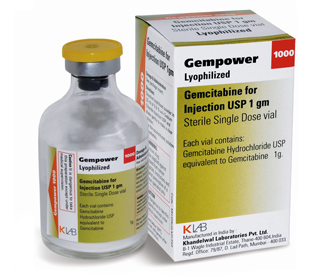
Gempower 1000 injection
Therapeutic Class
Oncology Chemotherapeutic Drugs
Indications
Indicated for the treatment of adult patient with 1.Non-Small Cell Lung Cancer in combination with cisplatin, indicated for the first line treatment of patients with in-operable, locally advanced (Stage IIIA or IIIB) or metastatic (Stage IV) non small cell lung cancer (NSCLC). 2.Pancreatic Cancer indicated as first-line treatment for patients with locally advanced (non-resectable Stage II or Stage III) or metastatic (Stage IV) adenocarcinoma of the pancreas. 3.Ovarian Cancer in combination with carboplatin, indicated for the treatment of patients with advanced ovarian cancer that has relapsed at least 6 months after completion of platinum based therapy. 4.Breast Cancer in combination with paclitaxel, indicated for the first-line treatment of patients with metastatic breast cancer after failure of prior anthracycline-containing adjuvant chemotherapy. 5.Advanced or metastatic transitional cell carcinoma (TCC) of the bladder.
Chemical Composition
Each vial contains Gemcitabine Hydrochloride USP equivalent to Gemcitabine 1000 mg.
Packaging
1 vial per box
Dosage & Administration
IV use only, Gemcitabine may be administered in an outpatient basis. Pancreatic cancer: Single agent use for adults: Administer IV at a dose of 1000mg/m² over 30 minutes once weekly for up to 7 weeks (or until toxicity necessitates reducing or holding a dose), followed by 1week of rest from treatment infuse subsequent cycles once weekly for 3 consecutive weeks out of every 4 weeks. Combination Use: Non-Small Cell Lung Cancer: Combination use with Cisplatin - Two schedules has been investigated and the optimum schedule has not been determined: 4- week schedule: Gemcitabine should be administered IV at 1000mg/m² over 30 minutes on Days 1, 8, and 15 of each 28 day cycle. Administer Cisplatin IV at 100mg/m² on Day 1 after the infusion of gemcitabine. 3- week schedule: Administer Gemcitabine IV at a dose of 1250mg/m² over 30 minutes on Days 1 and 8 of each 21 - day cycle. Administer Cisplatin IV at a dose of 100mg/m² after the infusion of Gemcitabine on Day 1. Bladder Carcinoma : IV infusion (over 30 min), 1000 to 1200mg/m²,once a week for 3 weeks, followed by a 1 week rest. Breast Carcinoma: Doses of 600 (with cisplatin) or 800 to 1250mg/m² by IV infusion once a week for 2 or 3 weeks, followed by a 1 week rest. Epithelial and Ovarian carcinoma: Doses of 800 to 1250mg/m² once a week for 3 weeks, followed by a 1-2 week rest have been used.
Contraindications
Hematology: Gemcitabine can suppress bone marrow function. Patients should be monitored for myelosuppression during therapy. Pulmonary: Pulmonary toxicity has been reported with the use of gemcitabine. Renal: Hemolytic Uremic Syndrome(HUS) and/or renal failure have been reported following one or more doses of gemcitabine. Hepatic: Serious hepatoxicity, including liver failure and death, has been reported very rarely in patients receiving gemcitabine alone or in combination with other potentially hepatotoxic drugs. PREGNANCY: Pregnancy Category D (Investigational or Post-marketing data show risk to the foetus. Nevertheless potential benefits may outweigh the potential risk) Gemcitabine can cause foetal harm when administered to a pregnant woman. Gemicitabine is embryotoxic causing foetal malformations cleft palate, incomplete ossification) at doses of 1.5 mg/kg/day in mice (about 1/200 the recommended human dose on a mg/m² basis). Embryotoxicity was characterized by decreased foetal viability, reduced live litter sizes, and developmental delays. There are no studies of gemcitabine in pregnant women. If Gemcitabine is used during pregnancy, or if the patient becomes pregnant while taking Gemcitabine the patient should be apprised of the potential hazard to the foetus.
Side Effects
Side effects are generally manageable with less than 1% of subjects discontinuing their therapy for any of the following side effects. Neutropenia was observed in 63% of subjects. This effects on the blood was the most frequent reason for reducing or limiting the dose of gemcitabine. Common adverse effects in clinical trials included nausea and vomiting (69%), fever (41%), edema or fluid retention (up to 34%), rash (30%), and flu- like symptoms (19%). Only about 10% of all subjects participating in Gemcitabine clinical trials discontinued therapy due to side effects. Hair loss was reported in 15% of subjects. This side effects was reversible, and none of the subjects experienced complete hairloss from their treatment. cancer, and advanced reiractory testicular cancer.
Drug Interaction
No specific drug interaction study if gemcitabine has been conducted.