

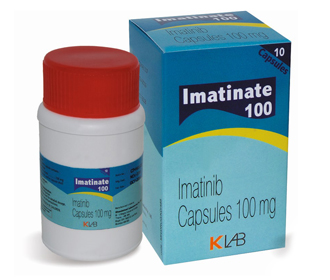
Imatinate 100mg Capsule
Therapeutic Class
Oncology Targeted Chemotherapeutic Drugs
Indications
Imatinib Mesylate is indicated for the treatment of newly diagnosed adult patients with. Philadelphia choromosome positive chronic myeloid leukemia (CML) in chronic phase. Follow-up is limited. Imatinib Mesylate is also indicated for the treatment of patients with Philadelphia chromosome positive chronic myeloid leukemia (CML) in blast crisis, accelerated phase, or in chronic phase after failure of interferon- alpha therapy. Imatinib Mesylate is also indicated for the treatment of pediatric patients with Ph+ chronic phase CML whose disease has recurred after stem cell transplant or who are resistant to interferon-alpha therapy. There are no controlled trials in pediatric patients demonstrating a clinical benefit, such as improvement in disease-related symptoms or increased survival. Imatinib Mesylate is also indicated for the treatment of patients with kit (CD 117) positive unresectable and/ or metastatic malignant gastrointestinal stromal tumors (GIST). The effectiveness of Imatinib Mesylate in GIST is based on objective response rate. There are no controlled trials demonstrating a clinical benefit, such as improvement in disease-related symptoms or increased survival.
Chemical Composition
Each gelatin capsule contains Imatinib Mesylate quivalent to Imatinib 100mg.
Packaging
1 x 10's / box
Dosage & Administration
Therapy should be initiated by a physician experienced in the treatment of patients with chronic myeloid leukemia or gastrointestinal stromal tumors. The recommended dosage of Imatinate (Imatinib Mesylate) is 400mg/day for adult patients in chronic phase CML and 600mg/day for adult patients in accelerated phase or blast crisis. The recommended Imatinib Mesylate dosage in 260mg/m'/day for children with Ph+ chronic phase CML recurrent after stem cell transplant or who are resistant to interferon-alpha therapy. The recommended dosage of Imatinib Mesylate is 400mg/day or 600mg/day for adult patients with unresectable and/or metastatic, malignant GIST. The prescribed dose should be administered orally with meal and larger glass of water. Doses of 400mg or 600mg should be administered once daily, where as dose of 800mg should be administered as 400mg twice a day. In children, Imatinib Mesylate treatment can be given as a once-daily dose or alternatively the daily dose may be split into two - once in the morning and once in the evening. There is no experience with Imatinib Mesylate treatment in children under 3 years of age. Patients with mild and moderate hepatic impairment should be treated dat a starting dose of 400mg/day. Patients with severe hepatic impairment should be treated at a starting dose of 300mg/day. For patients unable to swallow the Capsules, the Capsules may be dispersed in a glass of water or apple juice. The required number of Capsules should be placed in the appropriate volume of beverage (approximately 50mL for a 100-mg capsule and 200mL for 400-mg capsule) and stirred with a spoon. The suspension should be administered immediately after complete disintegration of the capsule (s). Treatment may be continued as long as there is no evidence of progressive disease or unacceptable toxicity. In CML, a dose increase from 400mg to 600mg in adult patients with chronic phase disease or from 600mg to 800mg (given as 400 twice daily) in adult patients in accelerated phase or blast crisis may be considered in the absence of severe adverse drug reaction and severe non- leukemia related neutropenia or thrombocytopenia in the following circumstances; disease progression (at any time) failure to achieve a satisfactory hematologic response after at least 3 months of treatment, failure to achieve a cytogenetic response, in children with chronic phase CML, daily doses can be increased under circumstances similar to those leading to and increase in adult chronic phase disease from 260mg/m/day to 340mg/m'/ day as clinically indicated Dosage of Imatinib Mesylate should be increased by at least 50% and clinical responses should be carefully monitored. In patients receiving Imatinib Mesylate with a potent CYP3A4 inducer such as rifampin or phenyfoin. For daily dosing of 800mg and above, dosing should be accomplished using the 400-mg capsule to reduce exposure to iron.
Contraindications
Use of Imatinib Myselate is contraindicated in patients with hypersensitivity to imatinib. WARNINGS: Pregnancy Women of childbearing potential should be advised to avoid becoming pregnant. Imatinib mesylate was teratogenic in rats when administered during organogenesis at doses≥ 100mg/kg, approximately equal to the maximum clinical dose of 800mg/ day based on body surface area. Teratogenic effects included exencephaly or encephalocele, absent/reduced frontal and absent pariental bones. Female rats administered doses≥ 45/mg/kg (approximately one-half the maximum human dose of 800mg/ day based on body surface area also experienced significant post-implantation loss as evidenced by either early fetal resorption or stillbirths nonviable pups and early pup mortality between postpartum Days 0 and 4. At doses higher than 100mg/ kg, total fetal loss was noted in all animals. Fetal loss was not seen at doses ≤ 30mg/kg (one- third the maximum human dose of 800mg). Male and female rats were exposed in utero to a maternal imatinib mesylate dose of 45mg/kg (approximately one-half the maximum human dose of 800mg) from Day 6 of gestation and through milk during the lactation period. These animals then received no imatinib exposure for nearly 2 months. Body weights were reduced from birth until terminal sacrifice in these rats. Although fertility was not affected, fetal loss was been when these male and female animals were then mated. There are no adequate and well-controlled studies in pregnant women. If imatinib mesylate is used during pregnancy, or if the patient becomes pregnant while taking (receiving) Imatinib Mesylate the patient should be apprised of the potential hazard to the fetus.
Side Effects
Chronic Myeloid Leukemia The majority of Imatinib Mesylate treated patients experienced adverse events at some time. Most events were of mild-to-moderate grade, but drug was discontinues for drug- related adverse events in 3.1% of newly diagnosed patients, 4% of patients in chronic phase after failure of interferon-alpha therapy, 4% in accelerated phase and 5% in blast crisis. The most frequently reported drug-related adverse events were edema, nausea and vomiting, muscle cramps, musculoskeletal pain, diarrhea and rash (Table 5 for newly diagnosed CML, Table 6 for other CML patients). Edema was most frequently periorbital or in lower limbs and was managed with diuretics, other supportive measures, or by reducing the dose of matinib Mesylate. The frequency of severe superficial edema was 1.1%-6%. A variety of adverse events represent local or general fluid retention including pleural effusion, ascites, pulmonary edema and rapid weight gain with or without superficial edema. These events appear to be dose related, were more common in the blast crisis and accelerated phase studies (where the dose was 600/ mg/ day) and are more common in the elderly. These events were usually managed by interrupting Imatinib Mesylate treatment and with diuretics or other appropriate supportive care measures. However, a few of these events may be serious, or life threatening and one patients with blast crisis died with pleural effusion, congestive heart failure, and renal failure. Hematologic Toxicity Cytopenias and particular neutropenia and thrombocytopenia, were a consistent finding in all studies, with a higher frequency at doses ≥ 750 mg (Phase 1 study). However, the occurrence of cytopenias in CML patients were also dependent on the stage of the disease. In patients with newly diagnosed CML, cytopenias were less frequent then in the other CML patients. The frequency of grade 3 or 4 neutropenia and thrombocytopenia was between 2- and 3- fold higher in blast crisis and accelerated phase compared to chronic phase (see Table 7 and 8). The median duration of the neutropenic and thrombocytopenic episodes varied from 2 to 3 weeks, and from 2 to 4 weeks, respectively. These events can usually be managed with either a reduction of the dose or an interruption of treatment with Imatinib Mesylate, but in rare cases require permanent discontinuation of treatment. Hepatotoxicity Severe elevation of transaminases or bilirubin occurred in 3%-6% and were usually managed with dose reduction of interruption (the median duration of these episodes was approximately 1 week). Treatment was discontinued permanently because of liver laboratory abnormalities in less than 0.5% of CML patients. However, one patient, who was taking acetaminophen regularly for lever, died of acute liver failure. Gastrointestinal Stromal Tumours The majority of Imatinib Mesylate- treated patients experienced adverse events at some time. The most frequently reported adverse events were edema, nausea, diarrhea, abdominal pain, muscle cramps, fatigue and rash. Most events were of mild-to moderate severity. Drug was discontinued to adverse events in 7 patients (5%) in both dose levels studied. Superficial edema, most frequently periorbital or lower extremity edema, was managed with diuretics, other supportive measures, or by reducing the dose of Imatinib Mesylate. Severe (CTC Grade 3/4) superficial edema was observed in 3 patients (2%) including face edema in one patient. Grade 3/4 pleural effusion or ascites was observed in 3 patients (2%) Adverse events, regardless of relationship to study drug, that were reported in at least 10% of the patients treated with Imatinib Mesylate. No major differences were seen in the severity of adverse events between the 400 mg or 600 mg treatment groups, although overall incidence of diarrhea, muscle cramps. headache, dermatitis, and edema was somewhat higher in the 600 mg treatment group.
Drug Interaction
Drugs that may alter after Imatinib Plasma concentrations Drugs that may increase imatinib plasma concentrations: Caution is recommended when administering Imatinib Mesylate with inhibitors of the CYP3A4 family (e.g., Ketoconazole, itraconazole, erythromycin, clarithromycin). Substances that inhibit the cytochrome P450 isoenzyme (CYP3A4) activity may decrease metabolism and increase imatinib concentrations. There is a significant increase in exposure to imatinib when Imatinib Mesylate is coadministered with ketoconazole (CYP3A4 inhibitor). Drugs that may decrease imatinib plasma concentrations: Substances that are induces of CYP3A4 activity may increase metabolism and decrease imatinib plasma concentrations. Co-medications that induce CYP3A4 (e.g.Dexamethasone, phenyloin, carbamazepine, rifampin, phenobarital or St. Johns Wort) may significantly reduce exposure to Imatinib Mesylate. Pretreatment of healthy volunteers with multiple doses of rifampin followed by a single dose of Imatinib Mesylate increased Imatinib Mesylate oral-dose clearance by 3.8-fold, which significant (p<0.05) decreased mean Cm, and AUGs) In patients where rifampin or other CYP3A4 inducers are indicated, alternative therapeutic agents with less enzyme induction potential should be considered.