

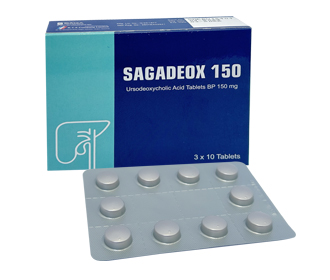
SAGADEOX 150 mg Tablet
Therapeutic Class
Cholagogues and cholelitholytic agents (agents that promote bile flow and dissolve gallstones)
Indications
Treatment of primary biliary cirrhosis (PBC) and for the dissolution of small to medium sized radiolucent, cholesterol-rich gall-stones in patients with a functioning gall bladder. Patients in whom surgery is contraindicated or who are anxious to avoid surgery.Paediatric population - Hepatobiliar disorder associated with cystic fibrosis in children aged 6 years to less than 18 years.
Chemical Composition
Each film coated tablet contains Ursodeoxycholic Acid BP : 150 mg
Packaging
3 x 10's per box
Dosage & Administration
Primary Billary Cirrhosis Adults and Elderly: 10-15mg per kg per day in two to four divided doses. Children: Dosago should be related to bodyweight. Dissolution of gallstones Adults and Elderly: The usual dose is 6-1 2mg/kg/day either as a single night time dose or in divided doses. This ray be increased to 15mg/kg/day in obese patients, if neccessary. The duration of treatment may be up to two years, depending on the size of the stone(s), and should be continued for three months after the apparent dissolution of the stone(s). Children: dosage should be related to bodywoight. Paediatric population Children with cystic fibrosis aged 6 year to less than 18 years: 20 rmg/kg/day in 2-3 divided doses,with further increase to 30 mg/kg/day if necessary.
Contraindications
Ursodeoxycholic acid tablet should not be used in patients: 1. With radio-opaque calcified gall-stones 2. With acute inflammation of the gall bladder or biliary tract. 3. With occiusion of the biliary tract (occlusion of the common bile duct or a cystic duct) 4. With frequent episodes of biliary colic 5. With impaired contractability of the gall bladder 6. With hypersensitivity to bile acids or any excipient of the formulation 7. Who are pregnant or breastfeeding, or in women who may become pregnant 8. With chronic liver disease, peptic ulcers or in those with inflammatoty diseases of the smallintestine and colon. Paediatric population Unsuccessful portoenterostomy or without recovery of good bile flow in children with biliary atresia.
Side Effects
Gastrointestinal disorders: In clinical trials, pasty stools or diarrhoea were common. Very rarely, severe right upper abdominal pain has occurred during the treatment of primary biliary cirrhosis. May give rise to nausea and vomiting. Hepatobiliary disorders: During treatment with Ursodeoxycholic acid, calcification of gallstones can occur in very rare cases making them unableto be dissolved by bile acid therapy and resulting in surgery for some patients. During therapy of the advanced stages of primary biliary cirrhosis, in very rare cases decompensation of hepatic cirhosis has been observed, which partally regressed after the treatment was discontinued. Skin and subcutaneaous disorders: Very rarely. urticaria can occur and may give rise to pruritus
Drug Interaction
Do not co-administer with charcoal, colestyramine, colestipol, or aluminium-based antacids/smectite – may bind the drug and reduce absorption. Ciclosporin: May increase absorption; monitor blood levels and adjust dose as needed. Ciprofloxacin, nitrendipine, dapsone: Possible reduced absorption or effect; monitor clinical response. Oral contraceptives, oestrogens, clofibrate: May increase biliary lithiasis risk, opposing gallstone dissolution therapy.